



Why Hybrid OTT + Satellite Delivery Makes Economic Sense
Based on: Yuriy Reznik, Cost-Optimal Satellite-Assisted Video Delivery, ACM Mile-High Video 2026
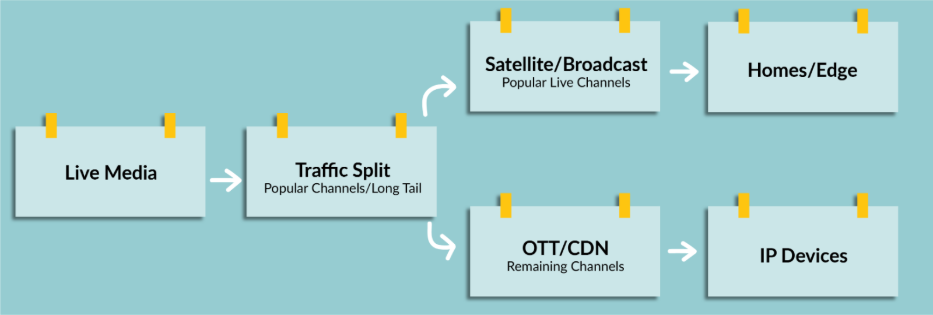
New analytical results developed through the 5G-EMERGE collaborative effort offer a clearer economic view of hybrid OTT + satellite delivery. Under the model's assumptions, a system that places the most popular live channels on satellite/broadcast and leaves the rest on OTT/CDN can reduce total delivery costs. It can also scale more cost-efficiently as audience demand and channel count grow.
Why does this matter?
OTT, satellite, and broadcast each have strengths in media delivery. OTT is flexible and reaches a wide range of IP-connected devices. Satellite and broadcast can be highly efficient when many viewers simultaneously consume the same live channel.
That makes hybrid delivery an increasingly important question. Instead of treating OTT and broadcast as competing models, it is more useful to ask how they can work together most efficiently. The new cost model developed through 5G-EMERGE addresses exactly that question.
Finding the right split
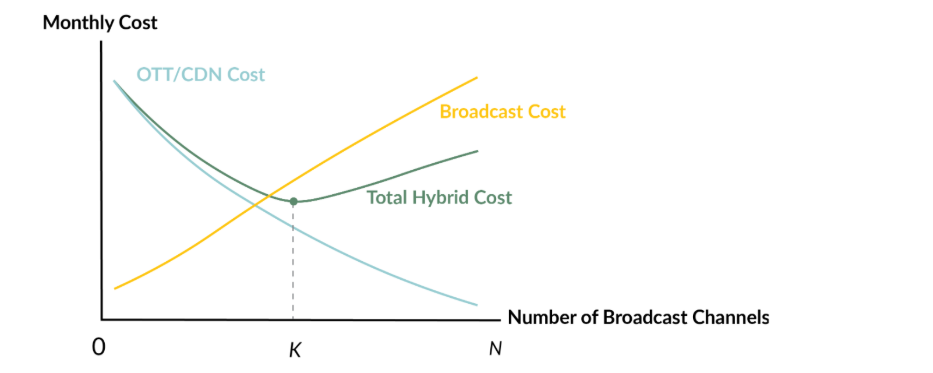
The central result is simple. If N live channels are available, only part of that portfolio should be sent over satellite/broadcast. Let K denote that number. As K increases, broadcast cost rises because more channels are carried on satellite paths. At the same time, OTT/CDN costs fall because more high-demand traffic is shifted away from unicast delivery.
These two trends create a minimum point. At low K values, most traffic remains on OTT. At high values of K, the system overspends on broadcast channels that do not reduce OTT traffic enough to justify the extra bandwidth. Between those two extremes lies an economically best operating point, denoted K∗.
This is one of the most useful outcomes of the model. Hybrid delivery is not just a general idea or a broad architectural direction. It also has an optimal depth. In practical terms, this means operators can think more precisely about how many channels should move to broadcast before the extra bandwidth no longer adds enough value.
Plain-language interpretation: K∗ is the point at which adding one more broadcast channel no longer saves enough OTT traffic to offset the extra broadcast cost.
The model also makes clear which factors shape this split: audience size, viewing time, the relative cost of satellite bandwidth and CDN traffic, and the concentration of viewing across channels.
Main results on cost scaling
The value of the hybrid approach is not limited to finding a single optimum. It also changes how delivery costs grow as the system scales.
Better scaling than pure OTT with viewing volume
In a pure OTT/CDN system, delivery cost tends to grow with viewing traffic. As more viewers watch for longer periods, edge traffic also grows. In the hybrid setting, the most frequently repeated live traffic can be routed to the broadcast path, thereby changing that growth pattern. Under the model, the minimum hybrid cost grows sub-linearly with viewing-volume terms such as audience size and watch time.
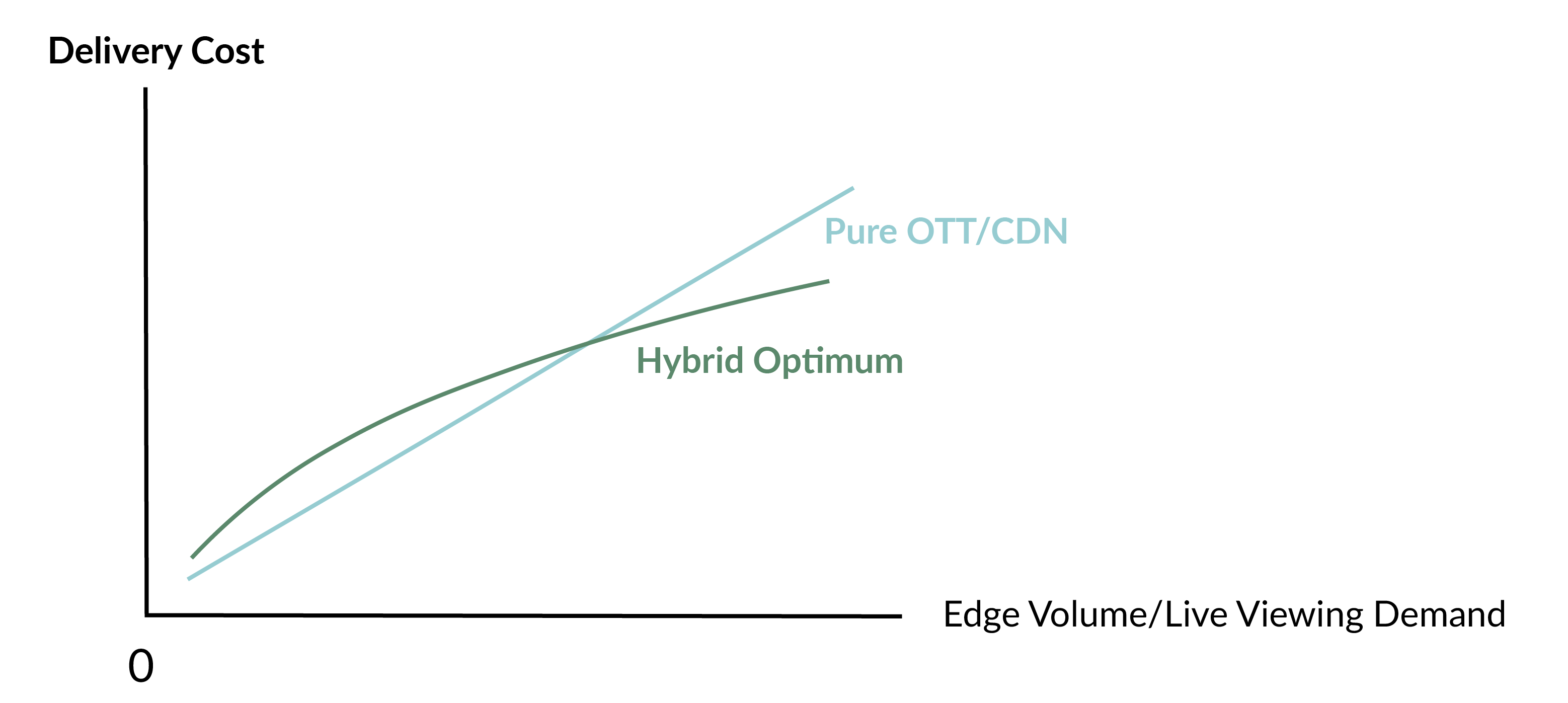
This result is important for large live events and channel portfolios with heavy shared demand, because it suggests that hybrid delivery can remain more manageable as audience load increases.
Better scaling than pure broadcast with channel count
A second result concerns the number of linear channels. In a pure broadcast system, carrying more channels generally requires more bandwidth, so cost rises with channel count. In the hybrid setting, only the channels that create the largest shared demand need to be placed on the broadcast path. The rest can remain on OTT. Under the asymptotic analysis, this leads to sub-linear cost growth with respect to the channel count.
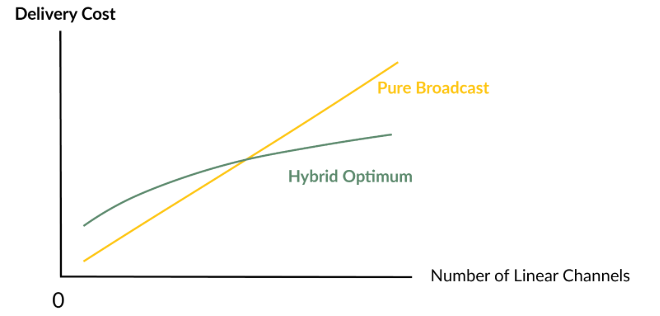
This matters for operators managing large or growing channel line-ups because it suggests a way to extend service portfolios without costs rising as quickly as they would in a pure broadcast-only design.
Why audience concentration is important
The model assumes a long-tail viewing pattern in which a relatively small number of channels attract a large share of total viewing. That assumption is important because the value of broadcast offload depends on how much demand is concentrated in those top channels.
When viewing is more concentrated, moving the most popular channels to broadcast tends to create more benefits. When demand is more evenly spread, the gain is smaller. This is why measurement, analytics, and content steering matter so much in practice. The closer an operator is to understanding real demand patterns, the easier it becomes to approach the economic optimum.
A representative example
Using real audience data for the top 120 US TV networks, the numerical example in the research yields an optimal value of about 29 broadcast channels. In that example, the resulting hybrid monthly cost is lower than either pure alternative: about 57% of the pure broadcast cost and about 41% of the pure OTT/CDN cost.
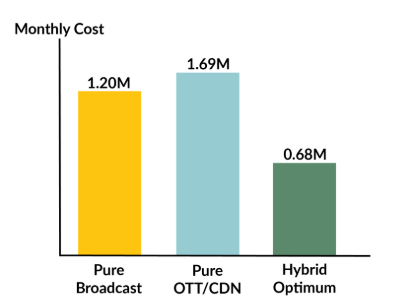
The importance of this example is not only the exact numbers. The broader point is that, under plausible assumptions, the gains can be material, and the optimum can be computed rather than guessed.
Why this strengthens the case for 5G-EMERGE
The wider 5G-EMERGE collaborative effort is building a standards-based architecture that brings together satellite, terrestrial IP, and 5G-based media delivery. These economic results add an important dimension to that work. They suggest that satellite-enhanced hybrid delivery is not only technically feasible and operationally interesting but also capable of offering a more efficient cost profile at scale.
That is relevant across the ecosystem: for broadcasters balancing reach and efficiency, for satellite operators developing new IP-native service models, for telcos and edge operators managing growing video demand, and for media platforms looking for more sustainable operating economics.
The role of Humans Not Robots
As a member of the 5G-EMERGE consortium, Humans Not Robots (HNR) contributes to the operational layer that helps make hybrid delivery practical and measurable. This includes QoS, QoE, and QoI analysis, content steering, media streaming enablement, and delivery efficiency assessment, including energy-footprint analysis through HNR to ZERO.
These areas fit naturally with the economic model. If there is a best point for splitting traffic between broadcast and OTT, then observability, steering, and optimization are part of what helps a real deployment move toward that point.
Conclusion
The new economic model developed through the 5G-EMERGE collaborative effort gives the industry a clearer way to think about hybrid OTT + satellite delivery.
The central message is simple: when popular live channels are placed on the broadcast path, and the rest remain on OTT, hybrid delivery can reduce costs and improve cost scalability under the model's assumptions.
Just as importantly, the model shows that there is a meaningful optimum rather than a vague middle ground. That makes the broader 5G-EMERGE effort especially significant, because it connects theory, architecture, and operational practice in a way that is directly useful for the future of media delivery.
Discuss the findings with HNR
As an active member of the 5G-EMERGE consortium, HNR has direct insight into the project’s architecture, optimization challenges, and market implications. If you would like to explore how hybrid OTT + satellite delivery could apply to your organization, this is the right time to start the conversation.
Reference
Y. Reznik, Cost-Optimal Satellite-Assisted Video Delivery, ACM Mile-High Video 2026.

Related News

Humans Not Robots Brings Its Biggest Ever Presence to IBC2026

Meet Humans Not Robots at IBC2026!
Advancing Media Sustainability: Highlights from the Ecoflow X Workshop Report
Ready To Start Saving?
Talk to HNR to reduce carbon emissions and costs from your digital infrastructure.
Book Demo


